
Category: ITSM

  • ITIL 4 and Aggregation Theory

    ITIL 4 and Aggregation Theory

    Back in the days of ITILv3, focusing on process was the right thing to do at the time. Building out robust, documented, repeatable processes went a long way toward consistent service delivery, and for many years, this approach to service management was enough. Then in the late two-thousands, significant changes in availability of IT service suppliers and the flattening of service delivery created a situation in which our customers, who had historically been a “captive” audience, now had choices. They quickly learned that we weren’t the only game in town. They had choices from outside the organization. Enter shadow IT. Were we still relevant to our customers? If our role wasn’t service provision, what was it?

    When ITIL 4 came around, the framework transitioned from an internal process-heavy focus to an external, customer-centered focus. At the time, the shift toward customer value “felt” right, but I couldn’t put my finger on the reason why. For a number of years, I had noticed that our customers were reasonably happy with the services we provided. But when we started engaging them strategically with BRM (Business Relationship Management) by fostering a relationship in order to understand their business and what they really valued, their happiness increased significantly. This practice worked in a big way, but why?

    Today, I made a connection between the outsized results we reaped with BRM and Aggregation Theory. The basic idea of aggregation theory is that value chains have three different groups: suppliers, distributors, and consumers/users1. Before the Internet disrupted everything, distribution was expensive. Take the example of newspapers. Newspapers had to be physically distributed. Competitive advantage was gained by the distributors (e.g. New York Times, The Washing Post, etc.) integrating the suppliers (i.e., journalists). The reason this worked was because customers outnumbered suppliers. A distributor that integrated supplier relationships had a significant advantage over distributors that didn’t. This was integration up the value stream.

    Post-Internet 2.0, the cost of the customer transaction decreased to practically zero as distribution became aggregated. Using our example, newspapers moved to digital editions and the cost of distribution decreased. But along with lowering customer transaction costs came de-personalization of the relationship. I missed the sight of my paperboy meandering down the street on his bike only to toss my paper in the bushes. In the new era, customers became weary of thousands of scattershot email solicitations, the rampant buying and selling of their information, and the always annoying automated feedback requests.

    “You’ve been chosen as one of our special customers to give us feedback today. For your time and effort, you’ll be eligible to receive a totally worthless coupon that you can’t redeem unless you stand on your head, pat your belly, and cough three times.”

    Customers actually missed drop-in visits from support team members, calls from their sales reps, and conversations with the engineering teams. The ubiquity of low-value customer connections had increased the value of the personal relationship. And it wasn’t just the relationship, it was the nature of what we did for them. While we continued to provide IT services (if not all), our role had to shift to that of a strategic partner. We had to grieve that we would no longer have the exclusive affections of our customers and accept that they had become poly-amorous, so to speak.

    This is why the focus on value and relationship has taken center stage today. Successful organizations will be those that provide the best user experience. This means an increased focus on customer relationships and a careful curation of customer experiences – integrating customers down the value stream. It means continuously understanding what the customer really values. It means getting out and talking to our customers, and I don’t mean our robots talking to their robots. I mean WE have to talk with THEM.


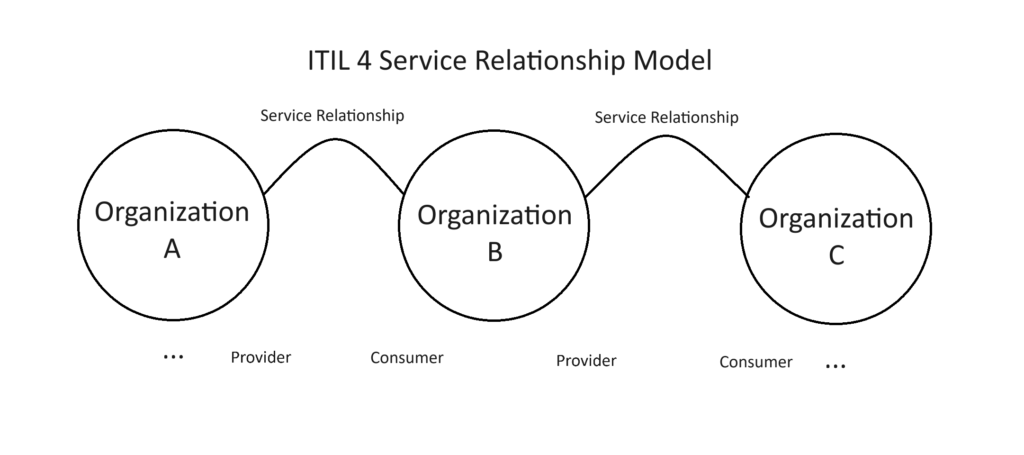
    1Incidentally, ITIL 4 simplifies this model by describing two top-level roles: providers and consumers, and then extending the concept to the three-part model by stating that organizations are both consumers and providers. ITIL 4 focuses on the relationships between organizations in the service relationship model.

  • Van Halen Breaks AI

    Van Halen Breaks AI

    I’m a huge Spotify fan. As a GenX’er, I love ’80s arena rock – Queen, Van Halen, AC/DC, Journey, Yes – you get the picture. Spotify feeds my hard rock nostalgia hunger. Spotify released a new feature earlier this year called DJ that is essentially an AI bot that examines your musical tastes and curates sets based upon them, including new selections it thinks you may like. According to Spotify, “The DJ knows you and your music taste so well that it will scan the latest releases we know you’ll like, or take you back to that nostalgic playlist you had on repeat last year.”

    After using DJ for some time, I can attest that it’s pretty good at creating sets of my favorites but pretty bad at selecting new music. For example, I can’t stand Rap, but it keeps setting me up with Rap/Hip-Hop sets which I quickly fast-forward through. DJ doesn’t seem to think fast-forwarding is disapprobation, so after a few songs, I finally get fed up and hit the “DJ” button to explicitly show my displeasure. It makes me wonder if they are selling plays of those artists which would explain why they keep pushing genres that the AI should know I don’t like.

    Several weeks ago, DJ selected a Van Halen song from their album 1984. The song was the instrumental first track on the album. Now, I had that record on vinyl when I was a kid. I know every lyric, every note, every riff. So when I heard the instrumental track 1984, I was expecting to also hear the second track on the album, Jump. I’ve always considered 1984 as an instrumental prelude to Jump. This is a “by design” artifact of “album rock” that creates associations and meaning out of the order tracks are set on the album. If you doubt me, take a look at Pink Floyd The Wall. Other examples of instrumental preludes include Yes’ Cinema (followed by Leave It) on their 90125 album and Queen’s We Will Rock You (We Are the Champions) from their album News of the World. Regarding this last example, I always get irritated when radio stations play We Will Rock You by itself. In the 80s and 90s, they would ALWAYS play them together. Somewhere along the road, radio media forgot this tacit knowledge and wisdom.

    And here’s the point. When I heard 1984, I let it run expecting Jump to play next, but it never came. Because I let it run, in subsequent weeks, DJ kept serving that song solo, aggravating me all the more. Why didn’t DJ know that those two songs were supposed to be together? Because AI doesn’t understand tacit knowledge. Van Halen had “broken” AI.

    AI will never be able to recreate the beautiful complexity of learning through living in the world with all of the experiences – personal, communal, cultural, and national – that come with it. This is why I don’t think AI is as far along as some would have us believe. Some folks agree with me. While AI may be helpful in many contexts, I don’t think it will ever replace the complexity of human reason completely.

  • It’s for fun…

    It’s for fun…

    On June 30, 2023, I retired from the Texas A&M University System after 29 years of service. Recent events on the main TAMU campus have led to me return almost immediately as a “working retiree.” What would bring me back, you ask?

    Over the last three years, the Technology Management program has completely reshaped and updated their degree to reflect a foundation in IT Service Management (ITSM). The new degree is a Bachelor of Arts in IT Service Management and receives its first cohort of students in in the fall, 2024. This degree reflects what I and many of our faculty believe is a new focus for IT professionals – one based on a foundation of IT Service Management with a strong portfolio of technical skills and plenty of room for our students to build out concentrations of study for the myriad IT-related jobs in and around the perimeter of the industry.

    But the changes in the degree are just the tip of the iceberg. We are working with educational psychologists (I’m one) to focus the program heavily on career development during the student’s academic tenure. This is a holistic approach based upon career assessment starting on day one and extending to graduation and beyond. With ITSM as the foundation, our program can be shaped and molded to accommodate virtually any IT career our students can think of.

    For example, this semester, I have a student that wants to be an IT-focused auditor. She has identified a minor in finance that, when coupled with her IT technical skills and ITSM foundation, will position her for a strong IT career most likely in the banking sector when she graduates.

    Why did I come back? It’s for fun.

  • ITIL MP Transition Course

    How to Transition from ITIL v3 to ITIL v4

    TTI is partnering with Global Knowledge to host an ITILv4 Managing Professional Transition course on October 12-16, 2020. This is an online course offering. The purpose of the course is to transition those of you with ITILv3 Expert certification into the new ITILv4 Managing Professional certification.

    The cost of the five-day course is $2,300. The format is online. The cost includes a Global Knowledge instructor for five days, printed courseware, and a voucher to take the certification exam. A retake of the exam is not included. This is a 30% discount off of the regular course price ($3,250) and you don’t have to pay for travel.

    A course overview can be found here. A detailed course syllabus can be found here. You must have the ITILv3 Expert designation or have a minimum of 17 credits under the ITILv3 scheme. ITILv4 Foundation is not necessary, although helpful.

    [ninja_forms id=2]